Inside a living cell, proteins are constantly being made, used and replaced. Some perform their jobs for minutes, others persist much longer. Yet even a correctly assembled protein can encounter conditions that interfere with its shape. The cell must then distinguish a temporary structural disturbance from damage that makes the molecule unsuitable for further use.
This is a remarkable biological problem. A cell cannot simply stop every activity while its molecular machinery is being maintained. It needs systems that operate alongside ordinary metabolism, recognizing vulnerable proteins and coordinating their fate. Scientists study these systems under the broad heading of proteostasis, or protein homeostasis.
Why a Protein’s Shape Matters
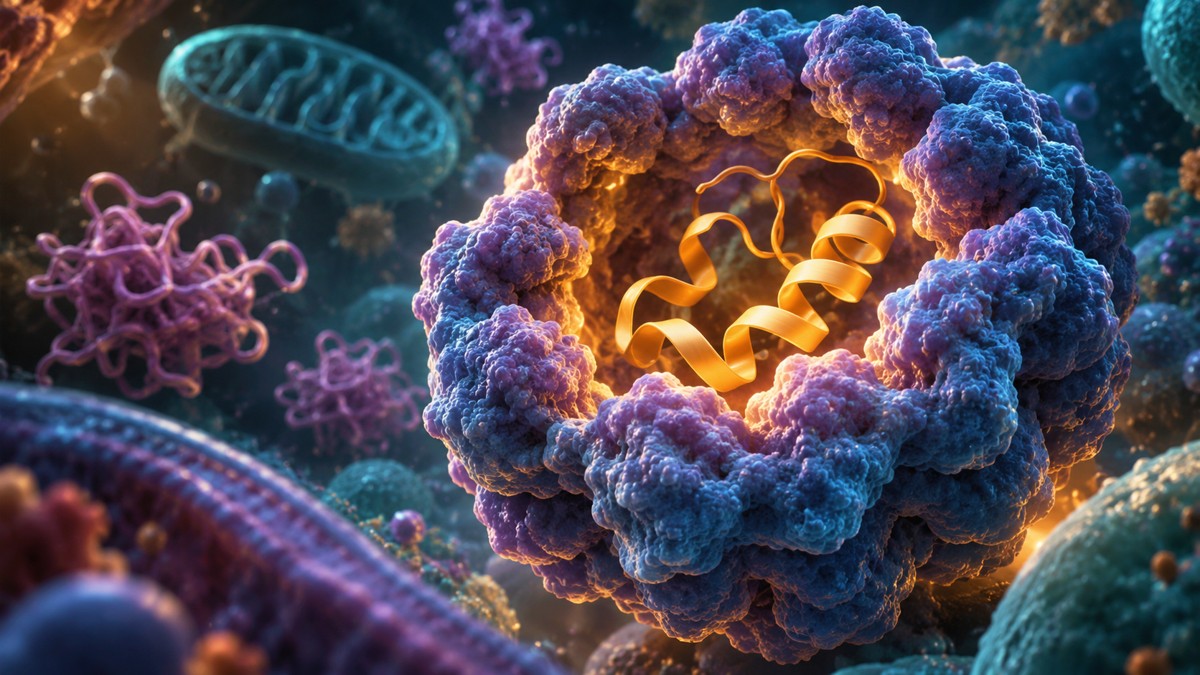
Proteins are chains of amino acids, but a chain alone is not a complete description of how a protein functions. Many proteins acquire a specific spatial arrangement that enables them to interact with other molecules. An enzyme, for example, may depend on the geometry of a small region within a much larger structure to recognize its substrate.
When that arrangement changes, the consequences vary. Some proteins can tolerate considerable structural flexibility, whereas others lose activity after a relatively small disturbance. Certain changes are reversible; others involve chemical damage that cannot be corrected simply by restoring the original shape.
The distinction helps explain why scientists use different measurements to study protein structure and activity. An observation about molecular shape cannot always reveal whether every biological function has been preserved. Likewise, a measurement of activity may not identify the structural change responsible for an observed difference.
Readers exploring peptide research information in Kansas City may encounter descriptions of amino acid chains, molecular interactions and cellular stress. Understanding the differences between these concepts provides a foundation for evaluating the evidence behind such descriptions.
How Molecular Crowding Complicates Protein Folding
A drawing of a cell often presents its interior as a spacious environment containing clearly separated components. In reality, the cellular interior contains numerous interacting molecules. Newly produced proteins must acquire suitable conformations in surroundings where encounters with other molecules are unavoidable.
During folding, portions of a protein that will eventually become concealed within its structure may temporarily remain exposed. These exposed regions can interact with neighboring molecules in ways that interfere with the folding process. Similar problems can arise when an existing protein loses some of its original structure.
In a 2011 review published in Nature, F. Ulrich Hartl and colleagues examined the contribution of molecular chaperones to protein folding and maintenance. Their work described why assistance with folding remains important even after proteins have been synthesized.
Chaperones are not interchangeable with the proteins they assist. They constitute a separate group of molecular machinery with specialized functions. Their activity allows researchers to examine protein maintenance as a coordinated biological process rather than an isolated property of an amino acid sequence.
What Heat Shock Proteins Actually Do
The term heat shock protein originated in research examining cellular responses to elevated temperatures. However, the name does not mean that these proteins function exclusively during exposure to heat. Members of several heat shock protein families also participate in ordinary cellular activities.
Some molecular chaperones recognize exposed regions of proteins that are vulnerable to inappropriate interactions. Their association with those regions can provide opportunities for productive folding or limit the formation of larger molecular assemblies. Other chaperones perform different tasks within the broader quality control network.
Heat shock protein 70, commonly called Hsp70, is a well studied example. It participates in cycles of association with protein substrates, working with additional molecular partners. These interactions depend on biochemical processes involving ATP, a molecule that contributes to energy transfer within cells.
Understanding the coordination of these processes matters because the presence of a chaperone does not guarantee a successful outcome. The characteristics of the substrate, the available molecular partners and the condition of the cellular environment all influence the response.
How Cells Change Their Response to Stressful Conditions
Cells do not necessarily maintain every component of their stress response machinery at a constant level. They can alter the expression of certain genes when their surroundings change, producing different quantities of proteins associated with cellular maintenance.
A transcription factor called heat shock factor 1, or HSF1, contributes to this regulation. Transcription factors participate in controlling the production of RNA from DNA, thereby influencing which genetic instructions are expressed.
Julius Anckar and Lea Sistonen reviewed HSF1 regulation in the Annual Review of Biochemistry in 2011. Their review examined how this regulatory machinery contributes to cellular responses to protein stress. The publication also identified questions surrounding the ways different kinds of stress are detected.
This distinction between regulation and outcome is important. An increase in the expression of a stress response gene does not independently establish that damaged proteins have recovered their original activity. Researchers must examine additional outcomes to determine what the cellular response has accomplished.
Can Proteins Recover After Forming Aggregates?
Protein aggregation occurs when protein molecules associate into larger assemblies. These assemblies are not all identical. Their physical properties depend on the molecules involved and the interactions that hold them together. Some are more difficult for cellular machinery to process than others.
An original investigation published in 2012 examined the cooperation between Hsp70, Hsp40 and Hsp110 in protein disaggregation. Researchers studied the recovery of aggregated proteins in controlled experimental systems and also investigated the role of Hsp110 in a nematode model.
The findings demonstrated that molecular cooperation can help reverse particular forms of aggregation. They did not establish that every aggregate in a human tissue can be dissolved or that an externally supplied research compound can reproduce the same response.
This example illustrates the value of identifying the actual experimental substrate. A study showing that a particular laboratory protein recovered its activity answers a different question from a study examining the behavior of a complex tissue over a prolonged period.
Why Cells Sometimes Break Down Proteins Instead of Restoring Them
Restoring the structure of an existing protein is not always the appropriate outcome. Some molecules have undergone irreversible changes, while others are no longer required. Cells therefore maintain mechanisms for breaking down proteins as well as mechanisms for assisting their folding.
Two important components of this system are the ubiquitin-proteasome pathway and autophagy. The former includes molecular machinery that recognizes selected protein substrates and breaks them into smaller fragments. Autophagy can deliver cellular material to compartments containing degradative enzymes, including larger structures that require a different approach.
Christian Pohl and Ivan Dikic examined these complementary quality control systems in a 2019 review published in Science. Their discussion emphasized that cellular degradation involves coordinated decisions influenced by the properties and locations of the material being processed.
Protein removal is therefore not necessarily evidence of cellular failure. It can represent an ordinary maintenance process. Researchers must distinguish the accumulation of damaged material from the activity of pathways responsible for removing it.
Where Naturally Occurring Peptides Enter the Picture
When proteins are broken down, their amino acid chains can be divided into shorter fragments. Some of these fragments are degraded further, while others can participate in specialized biological processes.
One particularly interesting example involves immune surveillance. Certain peptides derived from intracellular proteins can associate with major histocompatibility complex molecules. These complexes allow immune cells to examine information about proteins originating within other cells.
A 2022 review in Nature Reviews Immunology examined the pathways involved in antigen processing and presentation. The publication illustrates how the production, movement and selection of peptide fragments contribute to communication between cellular processes and immune recognition.
These naturally occurring fragments should not be confused with unrelated experimental peptides simply because both belong to the same broad chemical category. Their biological roles depend on their specific structures and the systems in which they occur.
Organizational background pages such as peptideskansascity.net/about-us/ can help identify the publisher of peptide-related information. Evidence about cellular peptide processing should be evaluated separately through original experiments and scientific reviews.
What a Cellular Resilience Experiment Can and Cannot Establish
Cellular resilience is a useful descriptive concept, but it is not a single standardized laboratory measurement. Scientists may investigate protein aggregation, gene expression, enzyme activity or the ability of cells to continue functioning after an experimental disturbance. Each measurement addresses a particular aspect of the response.
Consider an experiment in which researchers observe more heat shock protein after a disturbance. This could indicate that a stress response has been activated. Whether the response has restored cellular function requires additional evidence. A second experiment might examine protein aggregation and obtain a different perspective on the same biological process.
Readers should also distinguish observations from isolated proteins, cultured cells, animal models and human studies. Results from these systems can complement one another, but findings in a simplified model do not establish a health benefit in people. A molecular mechanism is not equivalent to evidence of clinical safety or effectiveness.
If terminology or references in a website’s published material are unclear, readers may contact the team responsible for the information. Clarification from a publisher can help identify relevant sources, but the scientific claims must ultimately be supported by the underlying evidence.
The study of protein maintenance offers a richer understanding of cellular biology precisely because it reveals many interconnected processes. Folding assistance, stress-responsive gene regulation, molecular recycling and peptide processing all contribute different pieces to the picture. Appreciating their individual roles makes it easier to recognize meaningful scientific discoveries without extending their conclusions beyond the research that produced them.