Invisalign has made digital treatment planning standard practice — orthodontists can now visualize a full sequence of tooth movements before a patient wears a single aligner. But one problem hasn’t gone away: teeth don’t always move the way the plan predicts.
The Tracking Problem
Invisalign clear aligners are good at translation and tipping, less reliable at rotation, intrusion, and extrusion. A 2025 systematic review found rotational accuracy with clear aligners averages only about 37–60%, with canines and premolars — round-shaped teeth that aligners struggle to grip — consistently the least predictable (Blouza et al., 2025, Predictability of Tooth Rotational Movements with Clear Aligners, Saudi Journal of Oral and Dental Research). Individual studies have found canine rotation accuracy as low as 35–36% (Kravitz et al., 2008, Angle Orthodontist).
When actual position diverges from the digital plan, the tooth is “off track” — and the aligner keeps pushing toward a position the tooth hasn’t reached, which compounds the error over subsequent stages.
How Orthodontists Currently Manage It
Today, correcting for lost tracking relies on clinical judgment: adding or modifying attachments, adjusting IPR, staging movements differently, overcorrecting, or — most commonly — rescanning and ordering refinement aligners. The evidence on attachments is more mixed than clinicians sometimes assume. Kravitz’s original 2008 study found attachments and IPR did not significantly improve canine rotation accuracy, and a 2021 retrospective study reached a similar conclusion, finding conventional attachments performed about as well as Invisalign’s proprietary “optimized” designs, with IPR again showing no significant effect on accuracy (Karras et al., 2021, American Journal of Orthodontics and Dentofacial Orthopedics). In other words, attachments remain a standard tool, but they’re not a reliable fix for rotation on their own — which is part of why refinements stay so common.
Refinements work, but they’re reactive. By the time a refinement scan happens, the patient has often worn several aligners that weren’t doing what they were designed to do.
The Case for Real-Time Prediction
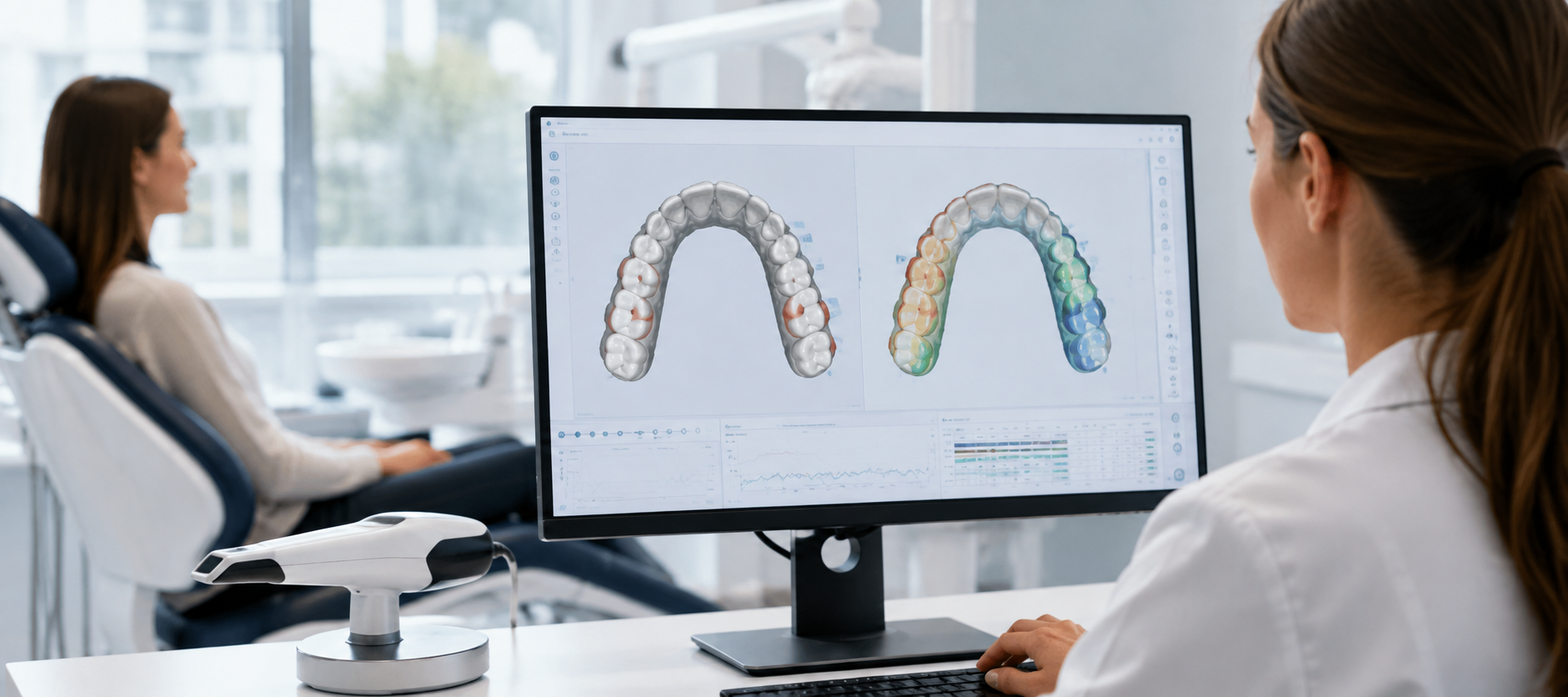
Invisalign Virtual Care already lets doctors review patient photos remotely and flag treatments that seem off course. That’s monitoring. The next step is prediction: a system that compares each new scan against the planned position, identifies which teeth are deviating, estimates where they’re headed, and recommends adjustments before the deviation compounds.
That shifts the model from:
Plan → wear aligners → discover a problem → refine
to a continuous loop:
Plan → measure → detect deviation → recalculate → adjust
The orthodontist still makes every clinical call. The software’s job is narrower: catch tracking loss earlier and with better data than a visual check can provide.
What This Could Change
Done well, this kind of feedback loop could:
- Catch tracking problems weeks before they’d otherwise be visible
- Reduce the number of refinement rounds needed per case
- Make treatment timelines more predictable for both doctor and patient
The technology pieces — 3D scanning, AI-assisted image analysis, predictive modeling — already exist individually. The open question is integration: whether aligner systems will move from a static, pre-planned sequence to one that adapts continuously to how each patient’s teeth actually respond.